My experience with the dark goddess
I have recently been one of the speakers in an online summit called Dark Goddess Rising, put together by Noraleen Adele.
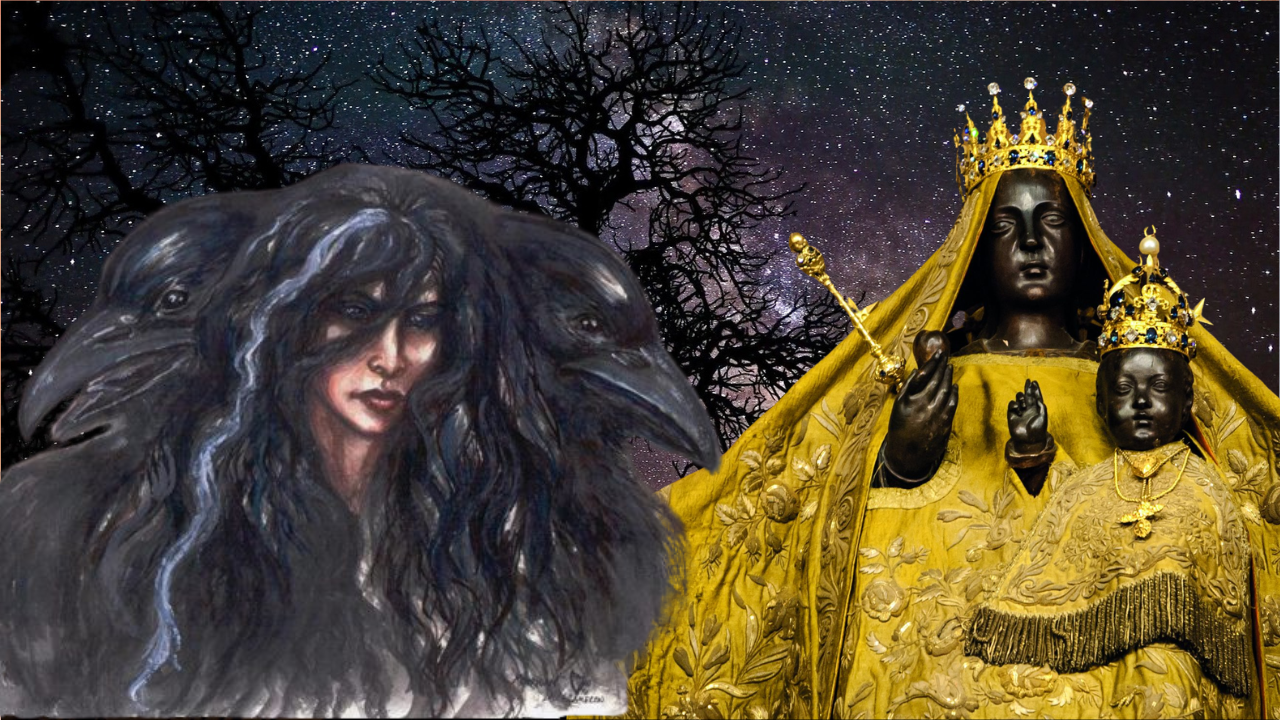
I want to tell you about my own journey with the dark goddess that I spoke about in the online summit. One of the dark goddesses that I have connected to the most is The Morrigan from Irish/Celtic mythology - she is a shapeshifter, sometimes appearing as a raven and sometimes as a triple goddess. She is associated with war, fate, death and sovereignty.
Although I’m not from the British Isles, I feel a strong connection to that mythology because I’ve lived most of my adult life in the UK, in London.
The Morrigan came to me while I was still in a relationship where I experienced narcissistic abuse. I woke up to the realisation about what type of person I was dealing with while I was still in that situation. It coincided with my divine feminine awakening. This is something that I have heard from other women too, that many have experienced these things simultaneously.
The Morrigan, as an archetype, helped me through this transition of waking up, and reclaiming my life and sovereignty and eventually leaving that situation and moving from the UK back to my home country of Sweden.
As Noraleen, who organised the online summit has said:
‘These are real energies that are within us and that can help us through different transitions and awakenings in our lives.’
This is related to Carl Jung and his theories about archetypes being a part of our collective unconscious and also our personal subconscious, and something that we can access.
A book that has impacted me a lot is Women Who Run with the Wolves: Contacting the Power of the Wild Woman by Clarissa Pinkola Estes. She is a poet, a Jungian psychoanalyst and a cantadora (which is a keeper of the old stories in the Latina tradition).
One of my favourite quotes from it is about spending time with the Wild Mother or Wild Woman in the underworld. And this is a kind of metaphor for being in the dark night of the soul and waking up from it:
“The time with Wild Woman is hard at first. To repair injured instinct, banish naïveté, and over time to learn the deepest aspects of psyche and soul, to hold on to what we have learned, to not turn away, to speak out for what we stand for … all this takes a boundless and mystical endurance. When we come up out of the underworld after one of our undertakings there, we may appear unchanged outwardly, but inwardly we have reclaimed a vast and womanly wildness. On the surface we are still friendly, but beneath the skin, we are most definitely no longer tame.”
To me she puts it so beautifully how feels is to come out of trialing times in our lives, and be the same person on the outside but there is something that has shifted on the inside.
There is a transformation and rebirth and sense of sovereignty that comes from having survived and come through certain parts of our lives,……and the dark goddess archetypes are especially helpful with this and with rebuilding our boundaries and our strength.
I also want to say that there is a lot of religious trauma amongst women especially and although I personally haven’t had a traumatic or negative experience with the specific Christianity that I grew up with, it still did not align for me fully.
But reclaiming the core teachings and the divine feminine within the Christian mythology, is a whole different thing.
There is a representation of the dark goddess in that tradition and that is the Black Madonna. She has continued to be a symbol of the great mother hidden in Christianity and has been revered, sometimes secretly.
I read an article about her and it says:
“The Black Madonna…carries a connotation of mystery, of the dark, of deep spiritual longing, of caretaking and miraculous healing. She is also seen, as by Romany people, apart from the religious mainstream and male-dominated hierarchical establishment, and represents “the mother of the oppressed, exploited, silenced, marginalised, and the reconciler of all races”.”
This point about her being seen as separate from the religious male-dominated mainstream reminds me of how the Nag Hammadi Scriptures, also called the Gnostic Gospels, have revealed the Gospel of Mary (which of course refers to Mary Magdalene - often referred to even by the Orthodox Church and now even the Catholic Church as the Apostle to the Apostles).
In the Gospel of Mary the true meaning of some of the Christian terms are revealed, that have been misunderstood in mainstream Christianity. One of those terms being is sin. According to the Gospel of Mary, sin does not exist.
And this is also reflected in newer texts like A Course in Miracles, which is a modern continuation of these Gnostic scriptures and Christian Mysticism, and it turns away from the dogmatic teachings, that some of us have grown up with - although it still uses some of the same terminology (even male dominated terminology), but in my eyes it’s done so that the reader can understand how we have misunderstood these terms.
But that is a topic that I will get to soon…