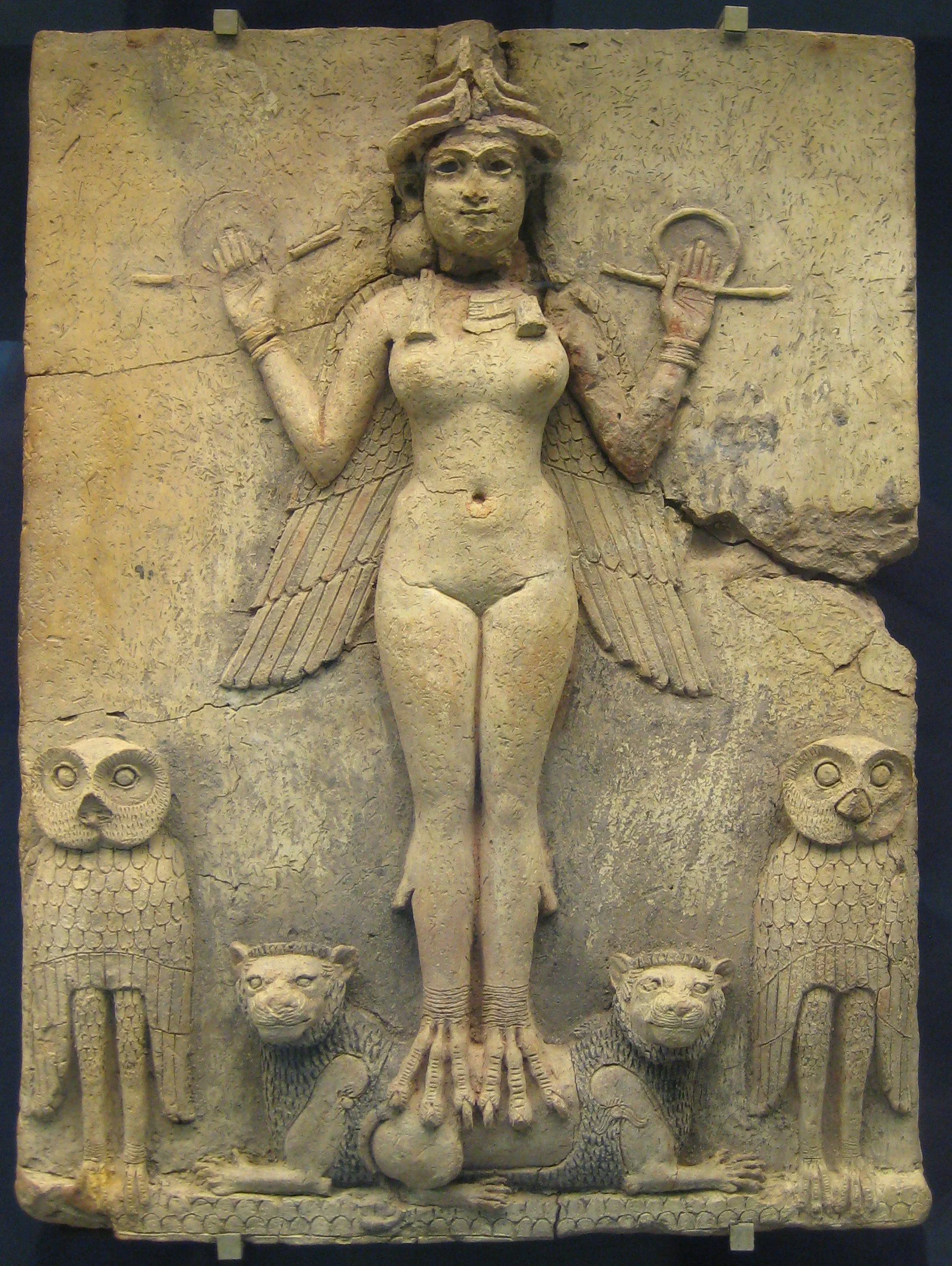
Before God there was the Goddess
What if I told you that there was a time when the main creator God was a Goddess and that she was the one who was seen as the ultimate source of everything and both women and men prayed to her.
There was such a time. And the mythology and scriptures around the Father God in later creation stories are even modelled after the earlier creation stories about the Mother Goddess.
Whether you believe in a higher spiritual power or not, this is still relevant and interesting as historical knowledge and because we are fed the idea through patriarchy that power, whether worldly or spiritual, is a male trait. And this affects us all, even if we don’t believe in it as such.
In the book The Creation of Patriarchy, Gerda Lerner details the history of how the Mother Goddess became the Father God instead, through patriarchal norms taking over. But it was not always like that.
What many perceive as something ancient and given, that the creator God is a father figure (whether you believe in God or not), is in fact a reinterpretation of something more ancient, which is the image of the creator as a Mother Goddess. And in this ancient tradition, female sexuality was celebrated instead of denigrated.
I have researched ancient goddesses and female archetypes for many years and most of us know about some of the powerful and interesting goddesses from different cultures. Some examples are Freja from Norse mythology, Athena from Ancient Greece and Kali Ma from Hinduism and there are so many more.
But back in Mesopotamia, which was located in modern day Iraq, and that existed for a few millennia BC, and before Ancient Greece and the Ancient Rome, the Mother Goddess was the ultimate creator and source of everything. She had different names but and two of the most common ones were Inanna and Ishtar.
Women in that society had already started being more and more subordinated, but there was a lag between the subordination of women in society and the subordination of the goddesses and priestesses in the religions. A good later example is the one of the Vestal virgins in Ancient Rome that were elite priestesses dedicated to the goddess Vesta. They, unlike normal Roman women, held privileged status and were legally emancipated. They could, for example, own property.
So when I say that women had started being more subordinated, this also means that women had not always been subordinated in the way we are used to hearing about in history. Patriarchy is created. It has not always existed. It’s man made. But that’s a topic for another time. Back to the goddesses.
The goddess Ishtar was regarded as all-powerful, not as a complement to other gods, but as powerful all by herself, and more powerful than any other gods. Female sexuality was also celebrated through the goddess, rather than vilified as in many later religious beliefs.
Gerda Lerner writes:
“…they celebrated the sacredness of female sexuality and its mysterious life-giving force, which included the power to heal. And in the very prayers appealing to the goddess’s mercy, they praised her as mistress of the battlefield, more powerful than kings, more powerful than other gods.”
And she details a typical prayer of the time, which I will read to you:
“Gracious Ishtar, who rules over the universe,
Heroic Ishtar, who creates humankind,
Who walks before the cattle, who loves the shepherd…
Who give justice to the distressed, the suffering you give them justice.
Without you the river will not open,
the river which brings us life will not be closed,
without you the canal will not open,
the canal from which the scattered drink,
will not be closed … Ishtar, … merciful lady …
Hear me and grant me mercy.”
I wanted to read that prayer to you, because to me it has such a resemblance to later prayers within Abrahamic religions because it talks about the all-powerful source and creator that created us, rules over the universe and who is the source of all good things and who can grant us mercy. You can almost hear and sense how the actual source of some of those later prayers and beliefs came from this even more ancient origin.
And the Goddess also represented duality, night and day, birth and death, light and darkness. The female force was seen as awesome, powerful and transcendent, not just as one part of a duality.
The supremacy of the Goddess also shows in the earliest myths of origin. In Egyptian mythology the primeval ocean, the goddess Nun, gives birth to the sun-god Atum, who creates the rest of the universe. In Babylonian myth the primeval sea is represented by the goddess Tiamat. In Greek mythology the earth goddess Gaia creates the sky and humans.
I’m not going to get into how the Mother Goddess was replaced by the Father God, but in the book this is also laid out.
When you realise that back then, the ultimate source of the universe was a feminine or female energy, a Goddess, a mother, it really turns some things on its head and gives a new perspective.
It makes us realise that things are not as we thought they were. And it really spikes the imagination for what could be instead of what is. We can use the old mythologies to create new stories.
Not to bring the past back, because that is neither possible nor desirable, but to take inspiration from the past to create something new and more complete.