What The Gospel of Mary and A Course in Miracles have in common
The principles of A Course in Miracles are compatible with the Gospel of Mary, and with Christian Mysticism that are all distinct from institutionalised patriarchal religion and dogmatic Christianity. The Gospel of Mary is part of the Nag Hammadi Scriptures, also called The Gnostic Gospels. I have the English translation and I have read it.
It’s believed to have been written in the second century AD, between year 120-180 AD. It was found again a little more than a hundred years ago. So the old gnostic and mystic teachings of the early christians were suppressed and discovered again fairly recently.
A Course in Miracles is a channelled metaphysical book written in the 1960s and 70s. I’ll call it The Course from now on for simplicity. I don’t think it’s a coincidence that the old mystic teachings have been translated and released again at the same time as new texts have come out that are compatible.
You might have heard about he Council of Nicaea which took place in the year 325 AD and organised by Roman Emperor Constantine I. They chose what writings should be in the official Bible and which ones should be excluded. This was a patriarchal council of men in power, who were part of and wanted to uphold institutionalised religion to help them hold power in different ways.
This is so far away from the mystic teachings that are part of The Gospel of Mary. In the Gospel of Mary it even says that “we should announce the good news…, and not be laying down any rules or making laws.” My interpretation of this is that dogmatic religion is not the way. Following rules and regulations in the hope of being obedient to the right religion is not the way.
But realising that Source, or what in the Gospel of Mary is called The Good, is within us, not outside.
In the Gospel of Mary - Sin does not exists. In The Course - sin is an illusion, and in effect does not really exist. Sin is merely a lack of love, a mistake to be corrected, not an evil to be punished. Some might say, what about people who commit horrible violent crimes towards others? But if we think about it, the concept of sin has not usually been used to combat those things.
It has been used towards normal people, and more often women, to shame us into obedience and to try to make us feel that we are inadequate and not good enough. Even the idea of original sin is connected to women. Of course, a gospel that says sin does not exist would be a threat to the institutionalised religions. And it has been suppressed, I think, partially because of it.
Because if you took away one of the very tools that gave them power over people, by being able to dangle the idea of sin over people and especially women, in order to oppress them, then that will take away some of the psychological power that these religious institutions and teachings hold over people.
We are collectively the ‘Son of God’ - or what in the Gospel of Mary is called the Child of (humanity).
And what I often call Source (what some call God) is called The Good in Mary’s gospel - and to put it simply it’s Love - which is our Source. It’s the creative Source within us and the knowledge that we are all one.
A Course in Miracles clarifies these deep metaphysical concepts and reminds us that the creative force of love lies within ourselves, not outside us. It also reminds us that following dogma is not beneficial. It makes it clear that The Course is not a religion or a new dogma to follow.
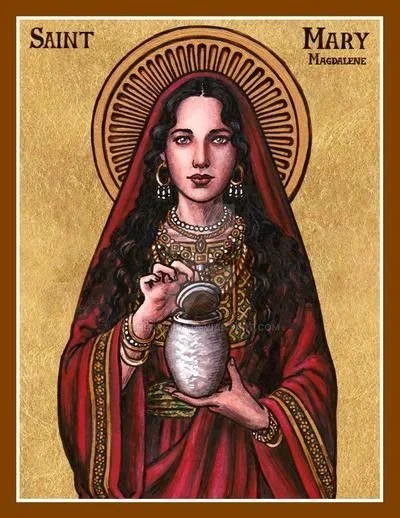
Back to Mary Magdalene herself. A woman was the most important disciple and the apostle to the apostles. Some of the other disciples questioned why she received teachings that they didn’t. It was because she had a higher understanding. She was called a prostitute by the Catholic Church, and tried to downgrade her importance. They then very recently corrected their mistake and admitted that they had been wrong.
The Course uses male pronouns for God and for humanity as a whole, which it calls the Son of God. Now how do I reconcile this with a woman centered spiritual view?
I have thought about this and in my view The Course uses the old religious concepts and words, including male pronouns for God and our collective consciousness in order for us to move beyond it, and to understand what it is we have misunderstood in these concepts and words.
It also clearly points out that words and scriptures, including The Course, are only signs trying to point us in the right direction. They are not dogmas to be worshipped and followed without critical thinking.
The true source of guidance is within ourselves, not in any scripture or outer teaching. Teachings and texts are only meant to lead us back to our inner knowing. Any teaching that points you away from your inner knowing is not beneficial, and can even be harmful.
When it comes to the wordings in The Course or any other text, because I don’t follow any text or specific teachings religiously, I have no problem with using other wordings for some of the concepts and teachings in. The Course itself broadly says that we should not hang on to any specific words or texts.
In conclusion, I don’t think it’s a coincidence that texts like the Nag Hammadi scriptures along with the Gospel of Mary have resurfaced again at the time it did, when humanity started to be ready for it.
When we started to be ready to see the real teachings behind the misconceptions and move away from the dogma and control of the institutionalised teachings that have misinterpreted these truths for so long.